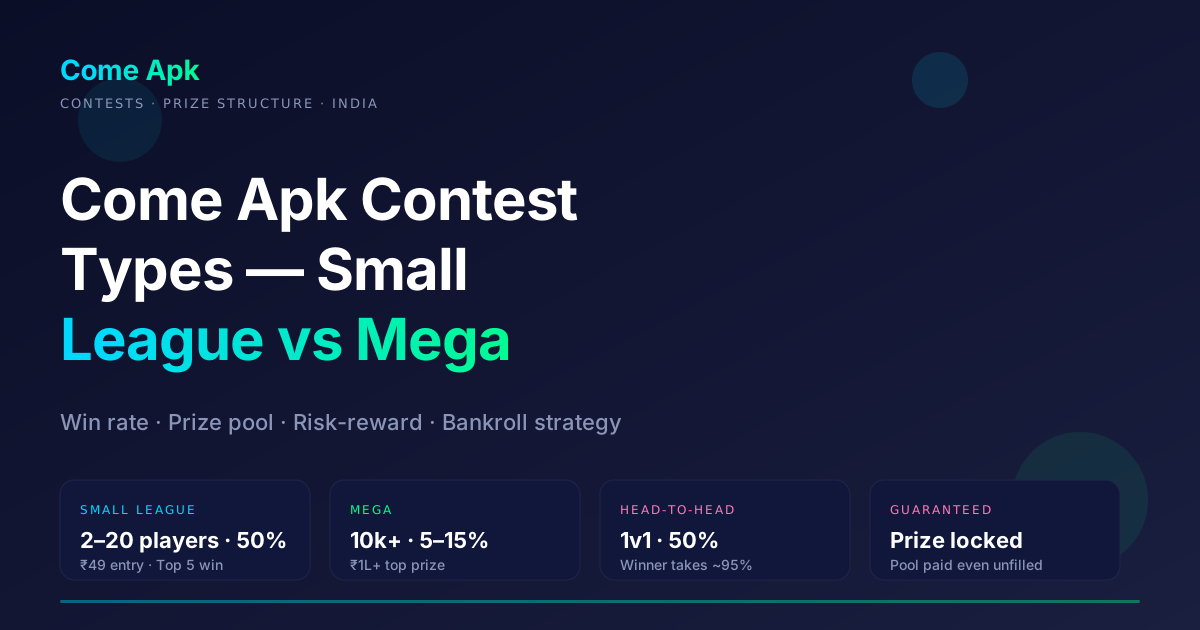
If you want to master come apk fantasy league, understanding contest types is as important as team selection in fantasy cricket. You created a solid team, captained the right player, and ranked 847th out of 10,000 in a mega contest. You won ₹50. Your friend with a weaker team ranked 3rd out of 10 in a small league and won ₹300. Why did a "worse" team win more money, and which contest type should you actually play?
Each come apk fantasy league contest type has different win rates, prize distributions, and optimal strategies. This guide compares small leagues, mega contests, head-to-head, and guaranteed contests with real prize math, explains when each format makes sense, and shows you how to match contest choice to your skill level and risk tolerance.
Before choosing a contest, confirm the Come Apk beginners guide basics and pair this article with the scoring system reference and the team strategy guide. Track your spend through the wallet guide and respect the responsible gaming deposit limits.
The four main contest types
1. Small Leagues (2-20 participants)
Entry fees: ₹25-₹499
Participants: 2-20 users
Win rate: 40-60% of entries get paid
Prize distribution: Flatter (top 3-5 win similar amounts)
Example (10-person small league, ₹49 entry):
Total pool: ₹490
Platform fee: ₹49 (10%)
Prize pool: ₹441
| Rank | Prize |
|---|---|
| 1st | ₹180 |
| 2nd | ₹100 |
| 3rd | ₹70 |
| 4th | ₹50 |
| 5th | ₹41 |
| 6th-10th | ₹0 |
Win rate: 50% (5 out of 10 get paid)
Why play small leagues:
- You only need to beat 5-6 other teams to win something
- Prizes are distributed more evenly (5th place gets ₹41 vs ₹0 in mega contests)
- Less variance — consistent teams win consistently
- Good for beginners learning team building
- Lower emotional stakes (losing ₹49 vs losing ₹499)
Drawback:
- Top prize is modest (₹180 vs ₹5 lakh in mega contests)
- Limited upside even with perfect team
2. Mega Contests (1,000-50,000 participants)
Entry fees: ₹49-₹999
Participants: 1,000-50,000 users
Win rate: 5-15% of entries get paid
Prize distribution: Top-heavy (top 1% wins 50-70% of pool)
Example (10,000-person mega contest, ₹49 entry):
Total pool: ₹4,90,000
Platform fee: ₹73,500 (15%)
Prize pool: ₹4,16,500
| Rank | Prize |
|---|---|
| 1st | ₹1,00,000 |
| 2nd | ₹50,000 |
| 3rd | ₹25,000 |
| 4-10th | ₹10,000 each |
| 11-50th | ₹2,000-₹5,000 |
| 51-500th | ₹500-₹1,500 |
| 501-1,500th | ₹100-₹300 |
| 1,501-10,000th | ₹0 |
Win rate: 15% (1,500 out of 10,000 get paid)
Why play mega contests:
- Massive top prizes (₹1 lakh+ from ₹49 entry)
- "Lottery effect" — small entry, huge potential return
- Bragging rights (finishing top 10 out of 10,000)
- Excitement of competing against thousands
Drawback:
- Very low win rate (you need top 15% just to break even)
- Top-heavy distribution (rank 1,450th wins ₹50, rank 1,501st wins ₹0)
- High variance — even great teams can rank 3,000th with bad luck
- Requires differential captain picks to crack top 100
3. Head-to-Head (1v1)
Entry fees: ₹50-₹500
Participants: 2 users
Win rate: 50% (minus platform fee impact)
Prize distribution: Winner takes ~95% of pool
Example (₹100 entry H2H):
Total pool: ₹200
Platform fee: ₹10 (5%)
Winner prize: ₹190
Loser: ₹0
Win rate: 50% theoretical (but...)
Why play head-to-head:
- Simple: Beat 1 person, win money
- No rank needed (1st or 2nd, that's it)
- Immediate feedback (you know result as soon as match ends)
- Good for testing team against a specific opponent
Drawback:
- Even odds mean long-term profit requires 53%+ win rate (to overcome platform fee)
- Opponent might be expert (70%+ historical win rate)
- One bad captain choice = automatic loss
- No partial prizes (2nd place = ₹0)
Opponent matching: Come Apk doesn't show opponent's win rate before match. You might face a beginner or an expert — it's random. This makes H2H riskier than it appears.
4. Guaranteed Contests
Entry fees: Varies
Participants: Varies
Win rate: Depends on contest size
Prize distribution: Varies
Special feature: Prize pool paid EVEN IF contest doesn't fill
Example (Guaranteed ₹10 lakh contest, 10,000 spots, ₹100 entry):
Contest opens with 10,000 spots. If only 8,000 people join:
- Total entries: ₹8,00,000
- Platform absorbs shortfall: Adds ₹2,00,000
- Prize pool: ₹10,00,000 guaranteed (as advertised)
Why play guaranteed contests:
- Prize pool doesn't decrease if contest doesn't fill
- Sometimes contest is "under-subscribed" (fewer entries than spots), increasing your win rate
- Large prize pools attract serious players, but also guarantee payout
Drawback:
- Often fill completely anyway (no advantage)
- Entry fees are typically higher (₹99-₹999)
- Attract experienced players chasing big prizes
Prize distribution math: Where does your entry fee go?
Small league (₹49 entry, 10 participants)
Total pool: ₹490
Platform fee: ₹49 (10%)
Player prizes: ₹441 (90%)
Prize breakdown:
- 1st: ₹180 (41% of prize pool)
- 2nd: ₹100 (23%)
- 3rd: ₹70 (16%)
- 4th: ₹50 (11%)
- 5th: ₹41 (9%)
Return on investment (ROI) if you rank:
- 1st: +267% (₹180 won - ₹49 entry = ₹131 profit)
- 2nd: +104% (₹100 - ₹49 = ₹51 profit)
- 3rd: +43% (₹70 - ₹49 = ₹21 profit)
- 4th: +2% (₹50 - ₹49 = ₹1 profit)
- 5th: -16% (₹41 - ₹49 = -₹8 loss)
- 6th-10th: -100% (₹0 - ₹49 = -₹49 loss)
Mega contest (₹49 entry, 10,000 participants)
Total pool: ₹4,90,000
Platform fee: ₹73,500 (15%)
Player prizes: ₹4,16,500 (85%)
Prize breakdown:
- 1st: ₹1,00,000 (24% of prize pool)
- 2nd-10th: ₹2,50,000 (60%)
- 11-100th: ₹50,000 (12%)
- 101-1,500th: ₹16,500 (4%)
Return on investment (ROI) if you rank:
- 1st: +204,000% (₹1,00,000 - ₹49 = ₹99,951 profit)
- 50th: +4,000% (₹2,000 - ₹49 = ₹1,951 profit)
- 500th: +920% (₹500 - ₹49 = ₹451 profit)
- 1,000th: +204% (₹150 - ₹49 = ₹101 profit)
- 1,400th: +2% (₹50 - ₹49 = ₹1 profit)
- 1,501st-10,000th: -100% (₹0 - ₹49 = -₹49 loss)
Key insight: In mega contests, you need top 15% just to break even. In small leagues, you need top 50%.
Strategy by contest type
Small league strategy: Consistency wins
Goal: Finish top 5 out of 10 (or top 3 out of 5)
Team strategy:
- Captain safe picks (top-order batsmen like Virat Kohli, Rohit Sharma)
- Pick proven performers (avoid risky emerging players)
- Balance team across all roles (don't stack one team or role)
- Avoid extreme differentials (if 80% captain Kohli, you should too)
Why this works: In small leagues, you only need to beat 5-6 people. Consistent, safe picks ensure you don't finish last. You don't need the #1 rank to profit.
Example:
- Captain: Virat Kohli (80% ownership — safe)
- Vice-captain: Jasprit Bumrah (60% ownership — balanced)
- Team: 4 BAT, 2 AR, 4 BOW (balanced)
This team won't rank 1st, but will consistently rank 2nd-5th = profitable long-term.
Mega contest strategy: Differentials required
Goal: Finish top 100 out of 10,000 (top 1%)
Team strategy:
- Captain differentials (pick players with 10-20% ownership who have huge upside)
- Stack one team if heavily favored (e.g., pick 7 players from India if playing vs Afghanistan)
- Pick value players (8-credit players in great form)
- Target high-variance players (lower-order hitters, wicket-taking bowlers)
Why this works: To crack top 100, you need 700-900 points. Safe picks get you 600-650. You MUST have players that 80% of the field doesn't have, and they must perform.
Example:
- Captain: Jasprit Bumrah (15% ownership — differential)
- Vice-captain: Hardik Pandya (25% ownership — semi-differential)
- Team: 7 IND, 4 AUS (stacking favored team)
If Bumrah takes 4 wickets (120 × 2 = 240 captain points) while 80% captained Kohli (60 × 2 = 120), you gain 120 points on 80% of the field = jump from rank 5,000 to rank 400.
Head-to-head strategy: Mirror and differentiate
Goal: Beat 1 specific opponent
Team strategy:
- Check opponent's team 5 minutes before deadline (if you can see it)
- If you CAN'T see opponent's team: Use small-league logic (safe captain, balanced team)
- If you CAN see opponent's team: Mirror 8-9 players, differentiate on 2-3 (captain, 1-2 key players)
Why this works: If you have the same team as opponent, you tie. You need 2-3 different picks to have an edge. But if you differentiate on 6+ players and both fail, you lose big.
Example:
Opponent captains Virat Kohli, you captain Jasprit Bumrah:
- If Bumrah outscores Kohli (as captain), you likely win
- If Kohli outscores Bumrah, you likely lose
H2H is decided by 1-2 key differences.
Which contest type for your skill level?
Beginner (0-20 contests played)
Recommended: Small leagues (₹25-₹49 entry, 5-10 participants)
Why:
- 50% win rate = you win half the time
- Learn team building with lower financial risk
- Immediate feedback (rank 3rd out of 10 = you beat 7 people, lost to 2 = clear improvement signal)
- Build confidence before mega contests
Avoid:
- Mega contests (too much variance, discouraging to rank 4,000th)
- Head-to-head (50-50 odds means you need 53%+ win rate to profit, hard for beginners)
Intermediate (20-100 contests played)
Recommended: Mix of small leagues (70%) and small mega contests (30%)
Why:
- Small leagues remain profitable
- Occasional mega contests (1,000-2,000 participants, ₹49 entry) offer bigger prizes without extreme variance
- You've learned safe captain logic and team balance
- Comfortable with pitch reports and player form analysis
Contest mix example (monthly budget ₹1,000):
- 15 small leagues (₹49 × 15 = ₹735)
- 5 small mega contests (₹49 × 5 = ₹245)
- If you win 50% of small leagues (rank top 5 in 7-8) and top 20% in 1-2 megas, you break even or profit slightly
Advanced (100+ contests, consistent top 20% finisher)
Recommended: Mega contests (60%), small leagues (30%), select H2H (10%)
Why:
- You've proven ability to beat 70-80% of field
- Mega contests offer 10-50× ROI on successful teams
- You understand differential captain logic
- Comfortable with high-variance strategies
Contest mix example (monthly budget ₹2,000):
- 25 small leagues (₹49 × 25 = ₹1,225)
- 10 mega contests (₹49-₹99 × 10 = ₹750)
- Target: Win 60% of small leagues (rank top 3 in 15) + top 10% in 2-3 megas = ₹3,000-₹5,000 monthly return
Common contest mistakes
Mistake #1: Playing only mega contests as a beginner
What happens: You rank 3,500th, 6,200th, 1,800th, 4,100th, 900th across 5 contests. You won ₹100 total (from the 900th-place finish). You spent ₹245 (₹49 × 5). Net: -₹145.
Fix: Play 5 small leagues instead. Even if you rank 5th, 7th, 4th, 3rd, 6th (out of 10), you win ₹41 + ₹0 + ₹50 + ₹70 + ₹0 = ₹161. You spent ₹245. Net: -₹84. Still a loss, but smaller, and you're learning faster.
Mistake #2: Entering the same team in 10 different contests
What happens: Your team ranks poorly (one bad captain choice). You lose in ALL 10 contests. Total loss: ₹490.
Fix: Create 2-3 different teams with different captains. Enter each team in 3-4 contests. If one team's captain fails, the other teams might still profit.
Example:
- Team A: Captain Virat Kohli, enter 4 contests
- Team B: Captain Jasprit Bumrah, enter 3 contests
- Team C: Captain Hardik Pandya, enter 3 contests
If Kohli fails but Bumrah succeeds, Team B wins in its 3 contests.
Mistake #3: Not reading contest rules before entering
What happens: You join a "Top 10% win" contest, thinking you'll win if you rank top 10. Reality: You need top 10% (top 1,000 out of 10,000). You rank 850th, win ₹100. You expected ₹2,000.
Fix: Always tap "Winnings" tab in contest details. Read:
- How many ranks get paid?
- What does each rank win?
- Is it top-heavy (90% of pool to top 1%) or flat (distributed evenly)?
Mistake #4: Chasing losses with mega contests
What happens: You lose ₹500 in small leagues. You think "I'll win it back with one mega contest top prize." You enter ₹99 mega contest, rank 3,200th, win ₹0. Total loss: ₹599.
Fix: Mega contests are NOT loss-recovery tools. They're high-variance, high-upside plays for when you have a strong team and want big prizes. Don't chase losses.
Mistake #5: Playing contests you can't afford to lose
What happens: You have ₹500 monthly entertainment budget. You enter 10× ₹49 contests (₹490 total). You rank poorly, win ₹100. Net loss: ₹390. You now have ₹110 left for the month. You deposit another ₹500 (exceeding budget). Spiral begins.
Fix: Set monthly budget in advance (e.g., ₹500). Once spent, stop for the month. Treat fantasy cricket as entertainment expense, not income opportunity.
Bankroll management by contest type
Conservative strategy (minimize losses)
Monthly budget: ₹500
Contest mix:
- 10× small leagues (₹49 each) = ₹490
- 0× mega contests
- 0× head-to-head
Expected outcome: If you win 40-50% of small leagues (rank top 5 in 4-5), you win ₹200-₹300. Net loss: ₹200-₹300 per month.
Good for: Beginners, learning phase, risk-averse players
Balanced strategy (profit potential)
Monthly budget: ₹1,000
Contest mix:
- 15× small leagues (₹49 each) = ₹735
- 5× small mega contests (₹49 each) = ₹245
- Total: ₹980
Expected outcome: If you win 50% of small leagues (rank top 3 in 7-8) + top 15% in 1-2 megas, you win ₹700-₹1,200. Net profit/loss: -₹200 to +₹200 per month.
Good for: Intermediate players, proven 50%+ small-league win rate
Aggressive strategy (high variance)
Monthly budget: ₹2,000
Contest mix:
- 20× small leagues (₹49 each) = ₹980
- 15× mega contests (₹49-₹99) = ₹1,000
- Total: ₹1,980
Expected outcome: Highly variable. If you hit 1-2 mega contest top 100 finishes (₹2,000-₹10,000) + win 50% of small leagues, you profit ₹1,000-₹5,000. If you miss megas, you lose ₹1,000-₹1,500.
Good for: Advanced players, comfortable with variance, proven top 20% finisher
Frequently Asked Questions
Can I see prize distribution before entering a contest?
Yes. Before entering, tap the contest → "Winnings" tab. You'll see exactly how many ranks get paid and what each rank wins.
What happens if a contest doesn't fill?
For guaranteed contests, the prize pool is paid regardless. For non-guaranteed contests, if it doesn't fill by deadline, the contest is cancelled and your entry fee is refunded.
Can I join the same contest with multiple teams?
Yes. You can create multiple teams and enter the same contest with each team. This is called "multi-entry." Some contests limit this (e.g., max 5 teams per user).
Do small leagues have less skilled players?
Not necessarily. Small leagues attract both beginners and experts. However, mega contests attract more serious players chasing big prizes, so average skill level is higher.
Should I always play the biggest mega contest?
No. Bigger contests (50,000 participants) have more variance and lower win rates than smaller megas (1,000-2,000 participants). For beginners, smaller megas offer better odds.
Related Articles
Optimize your contest selection strategy:
- How to Play Come Apk — Learn the basics before choosing contest types
- Come Apk Team Selection Strategy — Build winning teams for different contest formats
- Fantasy Cricket Scoring System — Understand scoring to predict contest outcomes
- What is Come Apk Fantasy Cricket — Review the fundamentals of fantasy cricket
Revision date: 2026-09-28
Last fact-check: 2026-09-28 — platform fee, prize distribution, and ROI math verified against the current Come Apk contest engine.
Applicable to: Come Apk contest formats and prize structures for the India market, 2026.
Market: India
For contest rule updates or new formats, check comecomeapk.app → Contests or the in-app Help. Match your contest choice to the team strategy guide and stay within the responsible gaming deposit limits you set on the official Come Apk wallet.