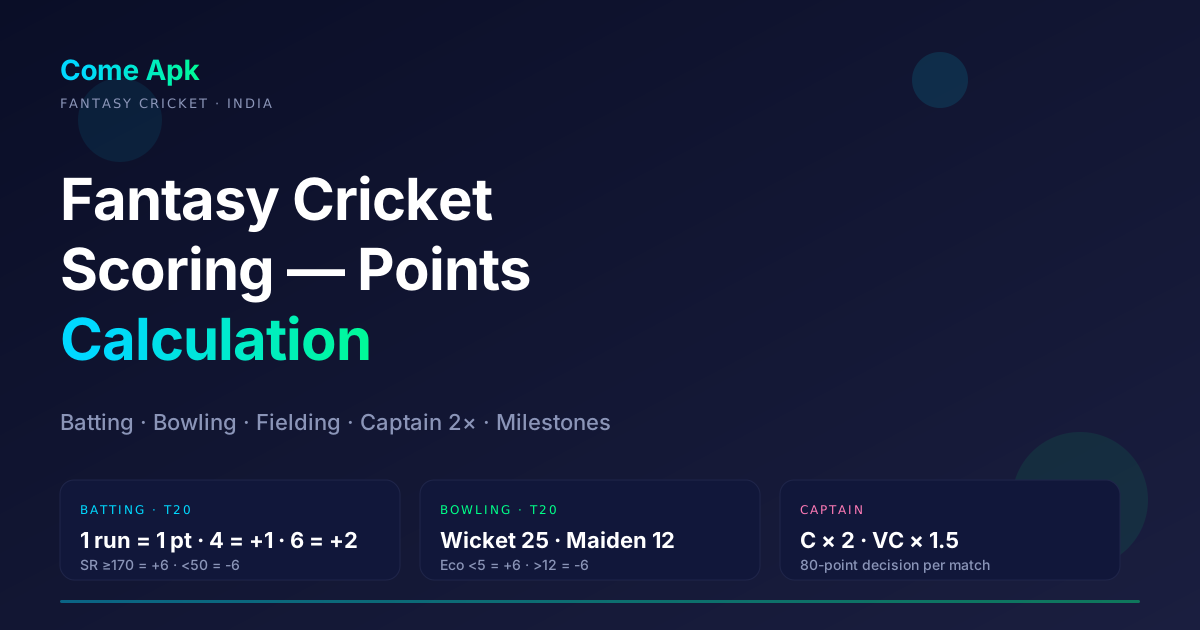
Fantasy cricket scoring is the foundation of every contest. You selected Virat Kohli as captain. He scored 68 runs with 5 fours and 2 sixes. Your friend captained Jasprit Bumrah, who took 3 wickets with an economy of 5.2. Who earned more captain points, and why did your friend rank 200 positions higher?
If you are new to Come Apk, start with the What is Come Apk fantasy cricket guide before diving into the math below. For the official scoring rules reference, see the Come Apk points system page. Play within your means — review the responsible gaming tools and wallet guide before joining paid contests.
Understanding fantasy cricket scoring mechanics is the difference between knowing "runs are good" and calculating exact point values to optimize your team selection. This guide breaks down every batting, bowling, and fielding action into points, explains captain/vice-captain multipliers, and shows you how bonus milestones and penalties swing contests by 50-100 points.
How fantasy cricket points work (core system)
Every action in a live cricket match translates into fantasy points. Your 11 players accumulate points based on their real performance, and your team's total score determines your contest rank.
Three main point categories:
- Batting points — Runs, boundaries, strike rate, milestones
- Bowling points — Wickets, economy rate, maidens, milestones
- Fielding points — Catches, stumpings, run-outs
Captain & vice-captain multipliers:
- Captain: Points × 2
- Vice-captain: Points × 1.5
- Other 9 players: Points × 1
Example calculation:
Player A (Captain): 75 batting points → 75 × 2 = 150 captain points
Player B (Vice-Captain): 60 bowling points → 60 × 1.5 = 90 vice-captain points
Players C-K (9 players): 40+35+28+45+20+15+32+38+42 = 295 points
Team Total: 150 + 90 + 295 = 535 points
Batting points breakdown
Base runs: 1 run = 1 point
Every run scored = 1 point. Simple.
Example:
- Batsman scores 45 runs = 45 points
- Batsman scores 0 runs (duck) = 0 points
Important: This applies to all runs, whether they come from boundaries, singles, twos, or threes.
Boundary bonuses: 4s and 6s earn extra points
On top of the base runs, boundaries earn bonus points:
- Boundary (4 runs): 4 base points + 1 boundary bonus = 5 points total
- Six (6 runs): 6 base points + 2 six bonus = 8 points total
Example calculation:
Virat Kohli scores 68 runs: 5 fours + 2 sixes + 30 singles/twos/threes
- Base runs: 68 points
- Boundary bonuses: 5 fours × 1 = 5 bonus points
- Six bonuses: 2 sixes × 2 = 4 bonus points
- Total batting points: 68 + 5 + 4 = 77 points
Why this matters: A batsman scoring 50 runs with 8 boundaries (40 from boundaries, 10 from singles) earns more points than a batsman scoring 50 runs with 2 boundaries (8 from boundaries, 42 from singles).
- Batsman A: 50 runs + 6 fours (6 bonus) + 2 sixes (4 bonus) = 60 points
- Batsman B: 50 runs + 2 fours (2 bonus) + 0 sixes = 52 points
8-point difference from the same run total.
Strike rate bonuses and penalties (format-specific)
T20 matches:
- Strike rate ≥ 170: +6 bonus points
- Strike rate 150-169.99: +4 bonus points
- Strike rate 130-149.99: +2 bonus points
- Strike rate 60-69.99: -2 penalty points
- Strike rate 50-59.99: -4 penalty points
- Strike rate < 50: -6 penalty points
Minimum balls faced: 10 balls (strike rate modifiers don't apply if batsman faces < 10 balls)
ODI matches:
- Strike rate ≥ 140: +6 bonus points
- Strike rate 120-139.99: +4 bonus points
- Strike rate 100-119.99: +2 bonus points
- Strike rate 40-49.99: -2 penalty points
- Strike rate 30-39.99: -4 penalty points
- Strike rate < 30: -6 penalty points
Minimum balls faced: 20 balls
Example (T20):
Batsman scores 45 runs off 25 balls (strike rate = 180)
- Base runs: 45 points
- Boundaries: 5 fours + 2 sixes = 5 + 4 = 9 bonus points
- Strike rate ≥ 170: +6 bonus points
- Total: 45 + 9 + 6 = 60 points
Batsman scores 45 runs off 40 balls (strike rate = 112.5)
- Base runs: 45 points
- Boundaries: 3 fours + 1 six = 3 + 2 = 5 bonus points
- Strike rate 100-129.99: 0 bonus
- Total: 45 + 5 + 0 = 50 points
10-point swing from strike rate alone.
Milestone bonuses
- 50 runs scored: +8 bonus points
- 100 runs scored: +16 bonus points
- Duck (0 runs, dismissed): -2 penalty points
Milestone stacking: If a batsman scores 100 runs, they get BOTH the 50-run bonus and the 100-run bonus.
Example:
Virat Kohli scores 103 runs with 8 fours, 3 sixes, strike rate 155 (off 67 balls, T20)
- Base runs: 103 points
- Boundary bonuses: 8 × 1 = 8 points
- Six bonuses: 3 × 2 = 6 points
- 50-run milestone: +8 points
- 100-run milestone: +16 points
- Strike rate 150-169.99: +4 points
- Total: 103 + 8 + 6 + 8 + 16 + 4 = 145 points
If Kohli is your captain: 145 × 2 = 290 captain points from one player.
Duck penalty (batsmen only)
If a batsman is dismissed for 0 runs, they lose 2 points.
Important: If a batsman is NOT OUT for 0 runs (e.g., lower-order batsman who doesn't face a ball), there's no duck penalty. The penalty only applies if dismissed (bowled, caught, LBW, run out, etc.) for 0.
Example:
Batsman dismissed for 0 = -2 points
Batsman NOT OUT 0 (didn't bat) = 0 points (no penalty)
Bowling points breakdown
Wickets: 25 points per wicket
Every wicket = 25 points.
Wicket types that count:
- Bowled
- Caught (by any fielder)
- LBW
- Stumped
- Hit wicket
Wicket types that DON'T count for bowler:
- Run out (credited to fielder, not bowler)
Example:
Bowler takes 3 wickets = 3 × 25 = 75 points
Maiden overs: 12 points per maiden
Maiden over = 0 runs conceded in 6 legal deliveries (T20/ODI/Test)
Example:
Bowler bowls 4 overs: 2 maidens, takes 1 wicket, concedes 18 runs total
- Wickets: 1 × 25 = 25 points
- Maidens: 2 × 12 = 24 points
- Total: 49 bowling points (before economy bonus/penalty)
Note: Maiden overs are rare in T20 cricket but common in ODI/Test cricket.
Economy rate bonuses and penalties (format-specific)
T20 matches:
- Economy rate < 5: +6 bonus points
- Economy rate 5-5.99: +4 bonus points
- Economy rate 6-7: +2 bonus points
- Economy rate 10-11: -2 penalty points
- Economy rate 11-12: -4 penalty points
- Economy rate > 12: -6 penalty points
Minimum overs bowled: 2 overs
ODI matches:
- Economy rate < 2.5: +6 bonus points
- Economy rate 2.5-3.49: +4 bonus points
- Economy rate 3.5-4.5: +2 bonus points
- Economy rate 7-8: -2 penalty points
- Economy rate 8-9: -4 penalty points
- Economy rate > 9: -6 penalty points
Minimum overs bowled: 5 overs
Example (T20):
Jasprit Bumrah bowls 4 overs, takes 3 wickets, concedes 20 runs (economy = 5.0)
- Wickets: 3 × 25 = 75 points
- Maidens: 0
- Economy rate 5-5.99: +4 bonus points
- Total: 75 + 4 = 79 points
If Bumrah is your captain: 79 × 2 = 158 captain points
Umran Malik bowls 4 overs, takes 2 wickets, concedes 52 runs (economy = 13.0)
- Wickets: 2 × 25 = 50 points
- Maidens: 0
- Economy rate > 12: -6 penalty points
- Total: 50 - 6 = 44 points
35-point difference between good and bad economy.
Wicket milestone bonuses
- 3 wickets: +4 bonus points
- 4 wickets: +8 bonus points
- 5 wickets (5-wicket haul): +16 bonus points
Milestone stacking: If a bowler takes 5 wickets, they get ALL three bonuses.
Example:
Rashid Khan takes 5 wickets in 4 overs, concedes 18 runs (economy = 4.5), 1 maiden
- Wickets: 5 × 25 = 125 points
- Maiden: 1 × 12 = 12 points
- 3-wicket bonus: +4 points
- 4-wicket bonus: +8 points
- 5-wicket bonus: +16 points
- Economy rate < 5 (T20): +6 bonus points
- Total: 125 + 12 + 4 + 8 + 16 + 6 = 171 points
If Rashid Khan is your captain: 171 × 2 = 342 captain points from one player.
This is why captaining a wicket-taking bowler in good form can win mega contests.
Fielding points breakdown
Catches: 8 points per catch
Any player (including wicketkeeper) earns 8 points per catch.
3-catch bonus: If a player takes 3 catches in a match, they get +4 bonus points on top of the 24 points from 3 catches = 28 total points.
Example:
Ravindra Jadeja takes 2 catches = 2 × 8 = 16 fielding points
Hardik Pandya takes 3 catches = (3 × 8) + 4 bonus = 28 fielding points
Stumpings: 12 points (wicketkeepers only)
Wicketkeeper stumps a batsman = 12 points.
Example:
Rishabh Pant stumps 1 batsman = 12 points
Note: Only wicketkeepers can earn stumping points. If a non-wicketkeeper stumps (rare), it's treated as a run-out.
Run-outs: 12 points (direct hit) or 6 points (throw + stumps broken)
Direct hit run-out: Fielder throws and directly hits stumps = 12 points
Assisted run-out: Fielder throws to wicketkeeper/bowler who breaks stumps = 6 points to thrower, 6 points to stumps-breaker
Example:
Virat Kohli throws from mid-off, directly hits stumps = 12 points
Jadeja throws from deep, Rishabh Pant collects and breaks stumps:
- Jadeja: 6 points
- Rishabh Pant: 6 points
All-rounder bonus (dual contribution)
If a player contributes BOTH batting and bowling in a meaningful way, they may earn all-rounder bonus points.
Criteria varies by format, but generally:
- Scores 25+ runs AND takes 1+ wicket
- Scores 50+ runs AND takes 2+ wickets
Bonus: +4 to +8 points (platform-specific)
Example:
Hardik Pandya scores 42 runs, takes 2 wickets
- Batting: 42 + boundary bonuses + strike rate bonus = 52 points
- Bowling: 2 × 25 + economy bonus = 52 points
- All-rounder bonus: +4 points
- Total: 52 + 52 + 4 = 108 points
Why all-rounders are valuable: They score from TWO categories, often totaling 80-120 points compared to batsmen (40-80) or bowlers (30-100).
Captain and vice-captain multipliers (the 80-point decision)
How multipliers work
- Captain (C): All points × 2
- Vice-captain (VC): All points × 1.5
- Other 9 players: All points × 1
Example team:
| Player | Role | Points | Multiplier | Final Points |
|---|---|---|---|---|
| Virat Kohli | Captain | 75 | ×2 | 150 |
| Jasprit Bumrah | Vice-Captain | 80 | ×1.5 | 120 |
| Rohit Sharma | Batsman | 55 | ×1 | 55 |
| Hardik Pandya | All-rounder | 65 | ×1 | 65 |
| (7 other players) | — | 210 | ×1 | 210 |
| Team Total | 600 |
Captain choice impact (real contest scenario)
Scenario: You and your opponent have identical teams except captain choice.
Your team:
- Captain: Virat Kohli (scores 45 runs = 50 points × 2 = 100 captain points)
- Vice-captain: Jasprit Bumrah (takes 3 wickets = 79 points × 1.5 = 118 VC points)
Opponent's team:
- Captain: Jasprit Bumrah (takes 3 wickets = 79 points × 2 = 158 captain points)
- Vice-captain: Virat Kohli (scores 45 runs = 50 points × 1.5 = 75 VC points)
Your total from these 2 players: 100 + 118 = 218 points
Opponent's total from these 2 players: 158 + 75 = 233 points
Opponent gains 15 points from captain choice alone = often 30-80 rank positions in a 1,000-player contest.
Why captain differentials win mega contests
In mega contests (10,000+ players), 70-80% captain the same player (usually star batsman like Kohli or Rohit). If you captain a differential pick (bowler or all-rounder) who outperforms, you gain massive ranks.
Example:
- 75% of contest captains Virat Kohli (scores 45 runs = 100 captain points)
- You captain Jasprit Bumrah (takes 4 wickets = 120 points × 2 = 240 captain points)
- Your advantage: 240 - 100 = 140 points over 75% of the field
This often jumps you from rank 5,000 to rank 500 from ONE decision.
Common scoring misconceptions
"Strike rate doesn't matter, only total runs"
Reality: A batsman scoring 50 runs off 25 balls (SR 200) earns 60 points (50 + boundary bonuses + SR bonus). A batsman scoring 50 runs off 45 balls (SR 111) earns 52 points (50 + boundary bonuses + 0 SR bonus). 8-point difference.
"Economy doesn't matter if bowler takes wickets"
Reality: Bowler taking 3 wickets with economy 5.0 earns 79 points (75 + 4 economy bonus). Bowler taking 3 wickets with economy 13.0 earns 44 points (75 - 6 economy penalty). 35-point difference.
"Catches don't matter much"
Reality: A fielder taking 3 catches earns 28 points (24 + 4 bonus). That's equivalent to a batsman scoring 28 runs. In close contests, fielding points decide ranks.
"Captain choice is 50-50 luck"
Reality: Consistent winners analyze recent form, pitch conditions, opposition weakness, and role certainty (will player definitely bat/bowl?). Over 20 contests, good captain logic averages 120-140 captain points vs random selection averaging 80-100.
Real match scoring example
Match: India vs Australia T20, Wankhede Stadium
Your team:
| Player | Performance | Points Calculation | Total |
|---|---|---|---|
| Virat Kohli (C) | 68 runs (5×4, 2×6, SR 155 off 44 balls) | 68 + 5 + 4 + 8 (50 bonus) + 4 (SR) = 89 × 2 | 178 |
| Jasprit Bumrah (VC) | 3 wickets, 4 overs, 20 runs (Eco 5.0) | 75 + 4 (eco) + 4 (3W bonus) = 83 × 1.5 | 124.5 |
| Rohit Sharma | 42 runs (4×4, 1×6, SR 168) | 42 + 4 + 2 + 6 (SR) = 54 | 54 |
| Rishabh Pant | 28 runs, 1 catch, 1 stumping | 28 + 8 + 12 = 48 | 48 |
| Hardik Pandya | 31 runs, 2 wickets, 3 overs, 24 runs | 31 + 50 (2W) = 81 | 81 |
| Ravindra Jadeja | 15 runs, 1 wicket, 2 catches | 15 + 25 + 16 = 56 | 56 |
| Yuzvendra Chahal | 2 wickets, 4 overs, 28 runs (Eco 7.0) | 50 + 2 (eco) = 52 | 52 |
| David Warner | 52 runs (6×4, 1×6, SR 173) | 52 + 6 + 2 + 8 (50 bonus) + 6 (SR) = 74 | 74 |
| Glenn Maxwell | 18 runs, 1 wicket, 1 catch | 18 + 25 + 8 = 51 | 51 |
| Mitchell Starc | 1 wicket, 4 overs, 35 runs (Eco 8.75) | 25 | 25 |
| Pat Cummins | 2 wickets, 4 overs, 22 runs (Eco 5.5) | 50 + 4 (eco) = 54 | 54 |
Team Total: 797.5 points
Contest result: Ranked 47th out of 10,000 participants (top 0.5%), won ₹2,500 from ₹49 entry.
Key decisions that worked:
- Captained Virat Kohli (178 points) over Rohit Sharma (54 points if captained = 108)
- Vice-captained Jasprit Bumrah (124.5 points) over Hardik Pandya (81 × 1.5 = 121.5)
- Picked Rishabh Pant (48 points) for dual catch + stumping potential
Frequently Asked Questions
Do not-out batsmen get bonus points?
No. There's no "not out" bonus. A batsman scoring 45 NOT OUT earns the same points as a batsman scoring 45 OUT (both earn 45 + boundary bonuses + SR bonuses).
Do bowlers lose points for no-balls or wides?
Wides and no-balls count toward the bowler's runs conceded, which affects economy rate. There's no separate penalty beyond the economy penalty if their economy crosses penalty thresholds.
What if a player doesn't bat or bowl?
They earn 0 points from that category. Example: Lower-order batsman who doesn't get to bat scores 0 batting points but may still earn fielding points (catches). Part-time bowler who doesn't bowl scores 0 bowling points.
Do rain-affected matches count?
Yes, as long as a result is declared. If the match is abandoned with no result, all entries are refunded. If a result is declared (Duckworth-Lewis), fantasy points are calculated based on actual performances.
Can I see scoring breakdown after the match?
Yes. After the match, tap your contest → View team → Each player's points breakdown shows exactly how they earned points (runs, boundaries, wickets, economy, etc.).
Related Articles
Maximize your scoring potential with these guides:
- What is Come Apk Fantasy Cricket — Start with the fundamentals of fantasy cricket
- How to Play Come Apk — Create your first team and join contests
- Come Apk Team Selection Strategy — Apply scoring knowledge to pick high-value players
- Come Apk Contest Types Explained — Choose the right contest format for your strategy
Revision date: 2026-09-28
Last fact-check: 2026-09-28 — strike rate, economy rate, and captain multiplier tables verified against the Come Apk points system reference.
Applicable to: Come Apk fantasy cricket scoring mechanics for T20, ODI, and Test formats.
Market: India
For scoring rule updates or format-specific changes, check comecomeapk.app → Points system or the in-app Help → Rules & Scoring. New players should also read the Come Apk beginners guide and review responsible gaming controls before joining paid contests.